

The Decision Environment
For centuries, we have treated decision-making as an analytical process.
Gather information.
Assess the options.
Evaluate the risks.
Choose the best alternative.
The assumption is simple: better analysis produces better decisions.
Yet anyone who has spent time around founders or shareholders knows that this is only part of the story.
Some decisions seem impossible despite overwhelming evidence.
Others emerge almost effortlessly from situations of profound uncertainty.
The difference is rarely the quality of the analysis.
It is the quality of the environment in which the decision is made.
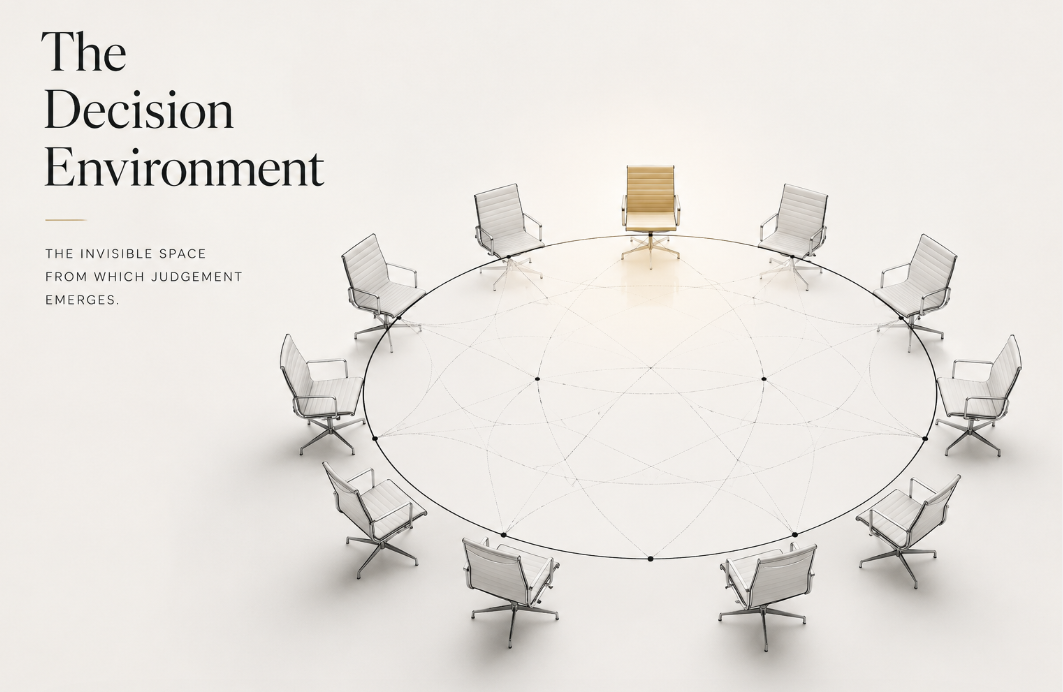
I call this the Decision Environment.
*
Decision emerges from the environment.
The Decision Environment is the invisible psychological and relational space from which judgement emerges.
It cannot be found in a financial model.
It does not appear in a board paper.
It is absent from governance manuals.
Yet it shapes every important decision long before that decision becomes visible.
By the time a decision reaches the boardroom, much of its outcome has already been determined by the quality of the Decision Environment in which it evolved.
This distinction matters because judgement is not simply an individual capability.
It is an environmental phenomenon.
Even the most experienced leader cannot consistently exercise sound judgement inside an environment dominated by fear, mistrust, hidden conflict or political calculation.
Conversely, ordinary groups can reach extraordinary decisions when the conditions allow genuine thinking to take place.
This is why two organisations can confront exactly the same facts and arrive at entirely different conclusions.
The analysis may be identical.
The Decision Environment is not.
Understanding this environment requires looking beyond strategy, governance and finance.
It requires attention to the unconscious dynamics that shape relationships, authority, conflict and responsibility—an area that psychodynamic thinking has explored for more than a century.
Artificial intelligence makes this distinction even more important.
AI dramatically improves our ability to generate information, identify patterns and model possible outcomes.
But none of these capabilities creates judgement.
If anything, they increase the temptation to confuse prediction with decision.
The more analysis becomes abundant, the more valuable the Decision Environment becomes.
Because judgement does not emerge from information alone.
It emerges from the quality of the human environment in which information is interpreted.
The objective, therefore, is not simply better decision-making.
It is better judgement.
Decisions are merely the visible expression of judgement.
The organisations that will thrive in the age of artificial intelligence will not necessarily be those with the most advanced technology.
They will be those that know how to preserve the conditions in which human judgement can still emerge.
Because in the end, competitive advantage will belong not only to those who generate the best analysis, but to those who protect the Decision Environment.
