

The Steel Swan: a new war against decision
What if the objective of modern warfare is no longer to conquer territory, but to destroy our ability to decide?
I recently read a remarkable article by Benoît Thieulin and Pierre Vallet in Le Grand Continent introducing a concept developed by Ukrainian researchers: the Steel Swan.
It changed the way I think about decision-making under uncertainty.
For decades, we have understood information warfare as an attempt to persuade: from spreading false information to manipulating public opinion.
Thieulin and Vallet argue that the Ukrainian experience points to something far more sophisticated.
The objective is no longer to persuade. It is to make decision itself impossible.
The enemy no longer needs you to believe a lie. It only needs to generate enough competing narratives, uncertainty and contradictory interpretations that your ability to judge—and ultimately to act—begins to collapse.
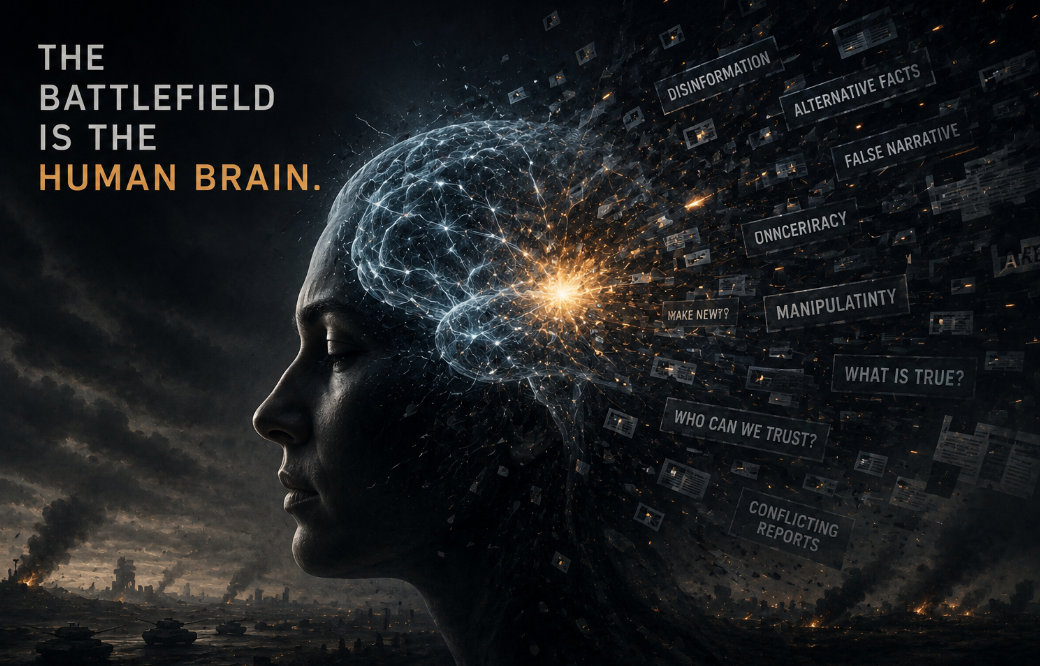
As the authors write, the battlefield is no longer territory.
It is the human brain.
This is what the Ukrainian military theorists Yuriy Danyk and Chad Briggs call the Steel Swan.
Unlike Nassim Nicholas Taleb's Black Swan, which describes a rare and unforeseen event, the Steel Swan is not about surprise. It is about paralysis.
The event is visible. The information exists. The facts are available.
And yet institutions fail to act because they can no longer distinguish signal from noise.
One of the article's most striking ideas is that the objective is no longer to persuade, but to weaponise rationality itself.
Democratic societies naturally seek evidence before acting. They verify, compare, debate.
Paradoxically, these very strengths can be turned into vulnerabilities when an adversary deliberately floods the information environment with endless competing interpretations.
The result is paralysis.
Reading this article, I couldn't help thinking that we may be entering a completely new era. Not only in warfare, but in decision-making itself.
What happens when the Steel Swan enters the boardroom?
That will be the subject of my next post.
References:
Thieulin, B., & Vallet, P. (2026). L'Ukraine se bat contre un ennemi que nous ne comprenons pas encore. Le Grand Continent.
Danyk, Y., & Briggs, C. (2023; 2026). Research on cognitive warfare and the Steel Swan.
Taleb, N. N. (2007). The Black Swan: The Impact of the Highly Improbable.
